
Jayshree P Upadhyay ' Mumbai September 9, 2014 Last Updated at 22:50 IST Top Stocks to Buy in 2014 8-10 Best Stocks for 2014 per month Highly Accurate Calls, Free Trial stockaxis.com/Stocks-to-buy-in-2014 Ads by Google 3 Add to My Page RELATED NEWS Foreign investor cap in bourses may be raised Sebi sets foreign portfolio investor limit of 10% per firm Sebi move on FPI regime grounded No clarity yet on FPI regime Jaimini Bhagwati: Correcting tax and disclosure anomalies Karbonn Titanium S5 Plus Be 1st to own latest Android phone with Dual SIM, 8 MP Camera & more!www.karbonnmobiles.com/S5_Plus 1Cr Life Cover @ Rs 543* Compare Premium of 46 Insurers Buy Online and save upto 55%www.policybazaar.com/TermInsur_Rate Ads by Google In a move that could increase the stake of foreign investors in Indian stock exchanges, the government is considering a threefold increase in the single-investor investment ceiling. Currently,a foreign portfolio investor (FPI) investment in an exchange is capped at five per cent. The finance ministry has written to the regulatory authorities to increase the ceiling to 15 per cent, said sources. The proposal is said to have in-principle approval from the Securities and Exchange Board of India (Sebi) and the Reserve Bank of India (RBI). The move would bring the FPI investment limit in line with those for financial institutions such as insurance companies and banks. NEW POLICY IN THE WORKS Single foreign investor limit in exchanges to be revised from 5% to 15% Sebi and RBI have given in-principle approval to the proposal Government to amend foreign investment policy BSE has 8 foreign shareholders holding 31% stake NSE has close to 20 foreign shareholders holding 36% stake The government allowed the foreign investors to invest in stock exchanges in 2006, with an overall cap of 49 per cent. This latter cap is likely to be unchanged. BSE and the National Stock Exchange (NSE), the two large nationwide bourses, are likely to benefit from the increase in limits. BSE has eight foreign investors, which cumulatively own about 31 per cent in it. The shareholding of Deutsche Boerse Group and Singapore Exchange Ltd are a little below the five per cent ceiling. NSE has about 20 foreign shareholders, holding around 36 per cent. Cyprus' Gagil and Goldman Sachs own five per cent each; Citi Group has around two per cent. "The finance ministry has received representations stating that the present limit of five per cent is a deterrent in attracting long-term anchor and strategic foreign investors in stock exchanges. Following which, the ministry has sought comments from both Sebi and RBI," said a person privy to the matter. A higher foreign investor limit will not only encourage more investment in Indian bourses but help in exchange of technology and products, said exchange officials. "A five per cent limit on the shareholding of any single investor or investor group is too small to encourage them to take sufficient interest in growth of the exchange," said an official associated with one, asking not to be named. The regulator and the government are also mulling a change in the shareholding of clearing corporations, which could also see individual foreign investors' cap being increased to 15 per cent. Some sections of the market believe that allowing a single FPI to own 15 per cent in a exchange could be detrimental to having a diversified shareholding. The Bimal Jalan committee, in the previous review of ownership and governance of stock exchanges in 2010, had debated whether there was a need to revise the cap. It was in favour of having an anchor investor, such as a bank or financial institution, which would own up to 24 per cent. Read more on: Fpi ' Sebi ' Rbi ' Nse ' Foreign Investor ' Singapore Exchange ' Finance Ministry Read More Investors vie for shares of stock exchanges Pick-up in sentiment, volumes boost bourses' unlisted shares HDFC Life Click2Protect+ Get Lump Sum + Monthly Income Benefit* @ Affordable Rate. Buy Now hdfclife.com/Click2ProtectPlus Retirement Calculator Plan Your Retirement Online in 2Min Calculate & Compare Premium Here! policybazaar.com/Retirement Ads by Google Advertisements Get a freedom to choose your own plan. Click here to know more... Data transforming the match-making business. click here Open a free Trading & Demat A/c with Sharekhan Leadership and Corporate Accountability-India. Click here Great fares to Europe from INR 54,000* Amsterdam. Click here Start Investing with the best Broker in india Important Facts about Infant Hearing Screening Gifting Solutions. Make easy & perfect! Find out what converged solutions can do for you. Smart Cloud Virtualized Server Recovery. Learn more. The perfect drive the perfect style. Book a test drive 3 Add to My Page Back to Top Quick Links Go LATEST NEWSAll NewsIn this section Ebola threatening Liberia's existence, minister warns IS threatens to assassinate Twitter employees Motherson Sumi, Eicher Motors, TVS Motor gain inclusion in F&O segment ABG, Bharati Shipyard rallies on hopes of government sops Pre-market: Five stocks to watch out for in trade today US manufacturing industry pushes India for free trade Dollar gains on Fed outlook, hurts shares Wall St ends lower as Apple shares fall post launch Ukraine ceasefire 'mostly holding': US Flipkart launches third private label Citron News you can use Rss icon Errors to avoid when filing returns What is Gratuity? What are NEFT and RTGS? Check your Income Tax Credit credit status form-26AS online Saving capital gain tax on sale of property Calculate tax on your house property income How to Check your EPF Balance & status online Featured Videos iPhone killers? The biggest threats to Apple's dominance video Jaguar takes the battle to BMW video The 5 biggest IPOs in U.S. history video Here is the next-gen spy plane... a blimp video MOST POPULARReadSharedCommented Supreme Court reserves order on coal block allocations Apple launches Watch, two iPhones & Apple Pay Guj rains: Hundreds evacuated in Vadodara, Army on stand-by Neel Mukherjee's book in Man Booker shortlist Mumbai airport keeps airlines guessing on Airbus A380 parking bay Market News A fourth of mutual fund equity assets concentrated in 10 stocks ICICI Bank, HDFC Bank, Infosys, SBI and L&T among fund managers' preferred bets Den Networks: Investing in new growth avenues Its tie-up with Snapdeal to launch a shopping TV channel looks like a win-win deal Sensex, Nifty retreat from record highs on profit taking The BSE Sensex and Nifty fell on Tuesday from their record highs in the previous session as investors chose to book profits in recent ... High agri imports under govt lens Dept of commerce seeks ideas to curb import dependence for supply of commodities, writes to sector bodies MCX hopes FTIL stake sale will conclude by month-end The exchange's clarification came in the wake of FMC rejecting its demand to allow approvals for contracts for the March quarter of 2015.

'We expect modest returns in 2026 versus the steep gains seen over the past few years.'

Escalating trade tensions amid a tariff war after Donald Trump took over as President of the United States (US) could adversely impact global growth and fuel inflation, an article on the "State of the Economy" in the Reserve Bank of India (RBI) monthly bulletin said.

Industry players said the sharp sell-off in February forced many companies to put off their listing plans

The equity benchmark indices posted their strongest weekly gains in years, driven by bargain hunting and optimism over a reversal in foreign portfolio investor (FPI) outflows. The Sensex rose 558 points, or 0.7 per cent, on Friday to close at 76,906, while the Nifty 50 gained 160 points to end at 23,350. Over the past five sessions, both indices advanced around 4.3 per cent - marking the Sensex's best weekly performance since July 22, 2022, and the Nifty 50's strongest rally since February 5, 2021.
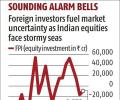
Foreign portfolio investors (FPIs) have withdrawn Rs 25,305 crore from domestic markets since September. FPIs were net sellers in the first two months of 2023, but from March to August, they purchased equities worth Rs 1.7 trillion. This selling trend has caused the National Stock Exchange Nifty Index to decline by 3.2 per cent from its September highs. FPI selling initially began in September as profit-taking but intensified due to rising US bond yields and uncertainty regarding the rate hike trajectory.

Rupee depreciation, if it continues, will likely pull the markets down further. Since September 2024, the rupee has declined by 3.1 per cent, the Nifty has dropped by 8.5 per cent during the same period, and the Sensex has fallen by 7.3 per cent. If the decline continues, markets will need to brace for more pain as it could push foreign portfolio investors (FPIs) to exit their positions faster than anticipated.

Certain foreign portfolio investors (FPIs), which operate as pooled investment vehicles (PIVs), may not be exempt from the additional disclosure mandates by the Securities and Exchange Board of India (Sebi) following an update in the standard operating procedures (SOPs) for custodians. An updated version of the SOPs has specified several conditions to be met for PIVs to benefit from the exemptions granted. These include no segregated portfolios, independent investment manager, and investors having pari-passu (equal) rights in the entity.

'Tax rate and stock markets are entirely two different things.'

Notwithstanding the ongoing decline in equity markets week after week, August has proven to be the most successful since December for initial public offerings (IPOs). In August of this year, six companies have collectively raised approximately Rs 4,269 crore through IPOs.

Foreign investors have continued selling in the Indian market, pulling out a massive Rs 85,790 crore (around $10.2 billion) from equities this month due to Chinese stimulus measures, attractive stock valuations, and the elevated pricing of domestic equities. October is turning into the worst-ever month in terms of foreign fund outflows. In March 2020, FPIs withdrew Rs 61,973 crore from equities.

Global trends, macroeconomic data, and the outcome of the US Fed policy meeting are the major factors that will drive the movement in the domestic equity markets this week, analysts said. "In the upcoming data-centric week, the focus will be on crucial releases, including inflation data from India and the US. "Indian inflation is expected to rise, while US inflation will remain steady.

The government is planning to introduce legislative changes to the Foreign Exchange Management Act (Fema) regulations, with a focus on easing the pathway for inflows from a foreign portfolio investor to transition seamlessly into foreign direct investments (FDI) once the FPI surpasses the 10 per cent ownership threshold in a company. This move stems from multiple requests by foreign investors seeking to streamline the reporting requirements that arise when their stakes in Indian firms cross the 10 per cent mark.

The heightened global uncertainty due to the US "reciprocal tariffs" on India may cause near-term corrections and market turbulence, but the long-term outlook remains constructive, market experts said on Thursday. The US has announced 27 per cent reciprocal tariffs on India, citing high import duties imposed by New Delhi on American goods.

The Indian government has appointed Finance Secretary Tuhin Kanta Pandey as the new chairman of the Securities and Exchange Board of India (SEBI). Pandey, a 1987-batch IAS officer, will replace Madhabi Puri Buch, whose three-year tenure ends on February 28. Pandey's appointment comes at a time when the markets are experiencing bear pressure due to withdrawals by foreign institutional investors (FIIs). Pandey has extensive experience in the finance ministry, having served as the longest-serving secretary in the Department of Investment and Public Asset Management (DIPAM) and the Department of Public Enterprises (DPE). He also played a key role in the framing of the 2025-26 Budget and the drafting of the new Income Tax Bill. Pandey's appointment is for an initial period of three years.

'For those in for the long haul, this is a God-given opportunity.' 'Your market is falling despite strong fundamentals, and such a clear roadmap has been announced.'

Shares worth over Rs 50,000 crore (or approximately $6 billion) are set to become freely tradable between now and April 10. Historically, such substantial volumes have been absorbed by a buoyant block-deal market.

The Securities and Exchange Board of India (Sebi) is contemplating the implementation of a same-day settlement cycle, known as T+0, in two phases. This is seen as a preliminary step towards instantaneous settlement. The shorter T+0 settlement cycle is being considered for the equity cash segment as an optional mechanism, in addition to the current T+1 (Trade plus one day) cycle.

The Real Effective Exchange Rate (REER) of the rupee moderated in December to 107.20 after hitting a peak of 108.14 in November, latest data released by the Reserve Bank of India (RBI) showed. The REER was 103.66 in January 2024. The rupee depreciated around 3 per cent against the dollar in 2024.

Though retail investors accounted for a larger number of outstanding shares of the NSE-listed companies at 15.29 per cent, the combined value of their holding was Rs 9.16 trillion. This was much lower than the value of holding of FPIs and DIIs.

'The market's sharp decline recently has shaken the confidence of retail investors, leading to increased selling.'

Water projects firm Vishnu Prakash R Punglia, the 20th company to launch its IPO in the current year, saw its shares closing at a 47 per cent gain over its issue price on Tuesday. Such a huge one-day pop is considered rare; however, it has become the norm this year. The average listing-day gain for these 20 IPOs in 2023 is 34 per cent, and their average gain to date stands at 46 per cent.

Small and midcaps are leading the charge in the latest market rebound. Since November 21, when the benchmark S&P BSE Sensex and the National Stock Exchange Nifty hit their recent lows and slipped into correction territory, the Nifty Smallcap 100 index has risen by 8 per cent, while the Nifty Midcap 100 has gained 5.7 per cent. Meanwhile, the Nifty 50 index has risen by 4.7 per cent during this period.

The Securities and Exchange Board of India (Sebi) has proposed that at least 10 per cent of corporate bond market trades by foreign portfolio investors (FPIs) should be done on the request for quote (RFQ) platform. At present, most trades in the corporate bond market are over-the-counter (OTC), creating a lot of opacity. The markets regulator has been nudging debt market participants such as mutual funds (MFs), alternative investment funds (AIFs) and brokers to use the RFQ platform to boost secondary market liquidity and transparency.

The Securities and Exchange Board of India (Sebi) has notified stricter timelines of just seven working days for foreign portfolio investors (FPIs) to disclose vital information. This could include informing their custodians about any false or misleading information about the fund or disclosing any change in structure or common ownership, or control of the investor group. The new changes have been brought into effect from March 14 through a notification amending the Sebi (FPIs) Regulations.

Brokerages believe that the Bharatiya Janata Party's (BJP's) stronger-than-expected showing in state elections reduces political risks for the domestic markets going into 2024. However, after the short-term excitement, the focus will soon shift to earnings, global liquidity conditions, and the interest rate trajectory. "BJP's win in the three state elections is much better than what exit polls suggested and reinforces the consensus expectations of a Modi win in the 2024 national elections with a greater likelihood of 300+ seats for the BJP.

Foreign investors have poured Rs 57,359 crore into Indian equities in September, making it the highest inflow in nine months, mainly driven by a rate cut by the US Federal Reserve. With this infusion, foreign portfolio investors' (FPIs) investment in equities has surpassed the Rs 1 lakh crore mark in 2024, data with the depositories showed. Going ahead, FPI inflows are likely to remain robust, driven by global interest rate easing and India's strong fundamentals.

High frequency indicators, like vehicles sales, air traffic, steel consumption and GST E-way bills, point towards a sequential pickup in momentum of economic activity during the second half of the fiscal 2024-25 and sustain moving forward, RBI Bulletin said on Wednesday. However, a strong dollar, driven by US economic resilience and trade policy pivots, could exacerbate capital outflows from emerging economies, push risk premiums higher, and intensify external vulnerabilities, said an article on 'State of the Economy' published in RBI's February bulletin.

Net flows from domestic institutional investors crossed Rs 5 trillion for the first time during a calendar year.

Domestic PMI data, US Federal Reserve meeting minutes and the progress on India-US trade deal negotiations are likely to influence movement in the equity market in the week ahead, according to analysts. Moreover, the trading activity of foreign investors would also influence the equity market trends.

In June, Sensex went up 6.6% and Nifty 6.9%, their best monthly gains since December 2023.

The Union Finance Ministry on Friday announced key amendments to foreign exchange (forex) regulations, including mandating government approvals for all investments originating from countries that share land borders with India. The latest amendments also seek to simplify cross-border share swaps and streamline key definitions, such as "control". The updated regulations have aligned the treatment of downstream investments made by overseas citizen of India (OCI)-owned entities with those owned by non-resident Indians (NRIs) on a non-repatriation basis.

After two months of net outflow, foreign investors turned buyers in June, infusing Rs 26,565 crore in Indian equities, driven by political stability and a sharp rebound in markets. Looking ahead, attention will gradually shift towards the budget and Q1 FY25 earnings, which could determine the sustainability of FPI flows, Vipul Bhowar, Director, Listed Investments, Waterfield Advisors, said.

Movement in the equity market this week will be guided by a host of macroeconomic data announcements, global trends and trading activity of foreign investors, analysts said. Stocks markets concluded the last week on a subdued note, as investors grappled with global uncertainties.

After the latest rout, the American depositary receipt (ADR) premium of HDFC Bank to its local shares has shrunk to nearly zero. Shares of HDFC Bank on Thursday fell 3.1 per cent to Rs 1,490, extending its two-day decline to 11 per cent. Meanwhile, the ADR has slumped over 15 per cent in the past two trading sessions.
The narrative on China is changing post the recent stimulus measures, and it will be hard for global investors to ignore the Chinese markets.

Largecap companies are generally less vulnerable to economic slowdowns than their mid- and smallcap counterparts.
Foreign Portfolio Investors (FPIs) continued their buying spree and poured close to Rs 4,800 crore in the Indian equity markets in the first week of January driven by confidence in the country's robust economic fundamentals. Additionally, they injected Rs 4,000 crore in the debt market during the period under review, data with the depositories showed. With expectations of a prolonged decline in US interest rates in 2024, there is an anticipation that FPIs will likely escalate their purchase, particularly in the initial months of the New Year leading up to the general elections, V K Vijayakumar, chief investment strategist at Geojit Financial Services, said.

'Legally clean farmland is difficult to find. It requires time, money, and legal effort to verify the title.'

The tax dept has served notices on about 36 foreign investors.
